
How to Think Like a Scientist

Source: @markuswinkler via Unsplash
SUMMARY | How to Think Like a Scientist: Applying Scientific Thinking to Business and Everyday Life
Scientific thinking is a powerful approach to understanding the world through curiosity, observation, and systematic inquiry. It follows a structured process of gathering evidence, testing ideas, and refining knowledge based on results. But scientific thinking isn't limited to laboratories—it is a valuable mindset for decision-making, problem-solving, and business strategy. By adopting a scientific approach, we can evaluate ideas objectively, test assumptions, and make data-driven decisions based on evidence.
This article explores the principles of scientific thinking and how they can be applied in daily life and business. We will cover the foundations of science, the importance of a scientific mindset, and four key methodologies that help us think like scientists.
“Science is curiosity in thoughtful action about the world and how it behaves.”
-
noun
the systematic study of the structure and behaviour of the physical and natural world through observation, experimentation, and the testing of theories against the evidence obtained.
"the world of science and technology"
ARCHAIC
knowledge of any kind.
"his rare science and his practical skill"
-
noun
a person who is studying or has expert knowledge of one or more of the natural or physical sciences.
"a research scientist"
8min read
what is science
At its core, science is the study of the world through observation and experimentation. Scientists follow a structured approach to gathering data, testing hypotheses, and refining their understanding based on evidence-based reasoning. This approach involves:
Observing the world
Collecting and analysing data
Formulating and testing hypotheses
The main branches of science are broadly divided into three core fields:
Credit: Danny Ong [2]
Physical Sciences: Study of energy and matter, including chemistry, physics, and astronomy.
Life Sciences: Study of living organisms, covering biology, botany, zoology, medicine, and genetics.
Earth Sciences: Study of planetary processes, such as geology, meteorology, oceanography, and ecology.
Additionally, Social Sciences—such as psychology, sociology, economics, and political science—apply scientific thinking to human behaviour and societal structures. Although this discipline emerged in the early 20th century, its roots trace back to ancient Greek inquiries into human nature, society, and morality. The term “behavioural science” emerged in the 1950s, emphasising experimental research to understand and predict social trends. This evidence-based approach has become increasingly relevant in business, leadership, and decision-making today.
Thinking like a scientist
A scientist studies the world by observing, listening, questioning, and testing ideas. While we all have intuitive beliefs about how and why things work, for a scientist, intuition alone isn’t enough. Thinking like a scientist and adopting a scientific mindset requires testing and validating ideas before accepting them as true. These ideas or predictions are known as hypotheses, and if a hypothesis is consistently supported by evidence, it may evolve into a theory. This process of inquiry and knowledge-sharing helps advance our understanding of the world.
The Scientific Method is a structured process scientists use to:
Observe – Identify a problem or pattern.
Question – Formulate a research question.
Hypothesise – Develop a testable prediction.
Experiment – Gather data through research and trials.
Analyse – Interpret the results and refine conclusions.
WHY THIS IS IMPORTANT
Scientific thinking offers a structured approach to problem-solving, helping us navigate uncertainty, identify patterns, and make informed, data-driven decisions. Whether in business, leadership, or personal growth, a scientific approach enables us to:
Make evidence-based decisions rather than relying on intuition.
Analyse trends and patterns that drive success.
Challenge biases and critically assess new ideas.
Innovate through experimentation and continuous learning.
For example, when assessing a market opportunity, rather than relying on assumptions, we can use research and testing to validate demand. This data-driven strategy improves decision-making and reduces risk.
A personal perspective: thinking like a scientist
Being endlessly curious about ideas, concepts, and so-called “facts” allows me to approach exploration and experimentation with a scientific mindset. By applying the scientific method, I can test ideas systematically to distinguish truth from assumption. I appreciate the elegance of developing hypotheses, testing them, and reflecting on the results. This critical thinking approach helps me refine my understanding of the world, stay open to different perspectives and continuously improve decision-making.
HOW TO WE DO IT : THE METHODOLOGIES AND MODELS
To think like a scientist, we can adopt methodologies and models that guide our exploration and problem-solving. Here are four key areas that illustrate how we can apply scientific thinking in our everyday lives and work:
-
The scientific method is a structured process used to test ideas and solve problems. It consists of five key steps:
· Observation: Identify a problem or pattern
· Question: Formulate a research question
· Hypothesis: Develop a testable prediction
· Experimentation: Collect data through tests or trials
· Analysis: Evaluate results and draw conclusions
This structured approach allows us to investigate questions methodically.
For example, when launching a new product, we can start by observing market trends and customer feedback (observation), ask why a particular product has succeeded or failed (question), propose a hypothesis about what customers want (hypothesis), test our assumptions through surveys or prototypes (experimentation), and analyse the data to determine if our hypothesis holds true (analysis). By following this method, we can make informed decisions based on evidence rather than assumptions.
-
Case studies serve as valuable learning tools
Case studies help apply scientific thinking to business challenges, illustrating how the scientific method can be applied in real-world scenarios. This allows for:
Learning from past successes and failures.
Adapting best practices to current challenges.
Making strategic, evidence-based decisions.
For example, a company might analyse a competitor’s product launch, identifying successful marketing strategies and pitfalls to avoid. By analysing this case study on what worked—such as marketing strategies and customer engagement—they can identify best practices and pitfalls to avoid in their initiatives.
-
Critical thinking is essential for evaluating information, questioning assumptions, and avoiding biases and considering multiple perspectives before drawing conclusions. To apply critical thinking:
Ask, “What data supports this claim?”
Look for counterexamples or contradictory evidence before forming conclusions.
Identify potential biases in information sources.
For example, when faced with a claim about a new trend or innovation, we can ask ourselves: What data supports this? Are there counterexamples? What are the potential biases in the information presented?
By adopting a critical mindset, we not only deepen our understanding but also become more effective problem solvers, ensuring that our decisions are grounded in reliable evidence rather than hype.
-
Science thrives on collaboration, bringing together diverse perspectives helps drive innovation and solve complex problems. In business and leadership, working with cross-functional teams allows for:
A broader range of expertise and ideas
More thorough testing and validation of strategies
Increased innovation through collective problem-solving
For example, when designing a sustainability initiative, collaborating with experts from engineering, finance, and marketing ensures that solutions are both technically feasible and commercially viable.
Credit: Ozo.Art [3]
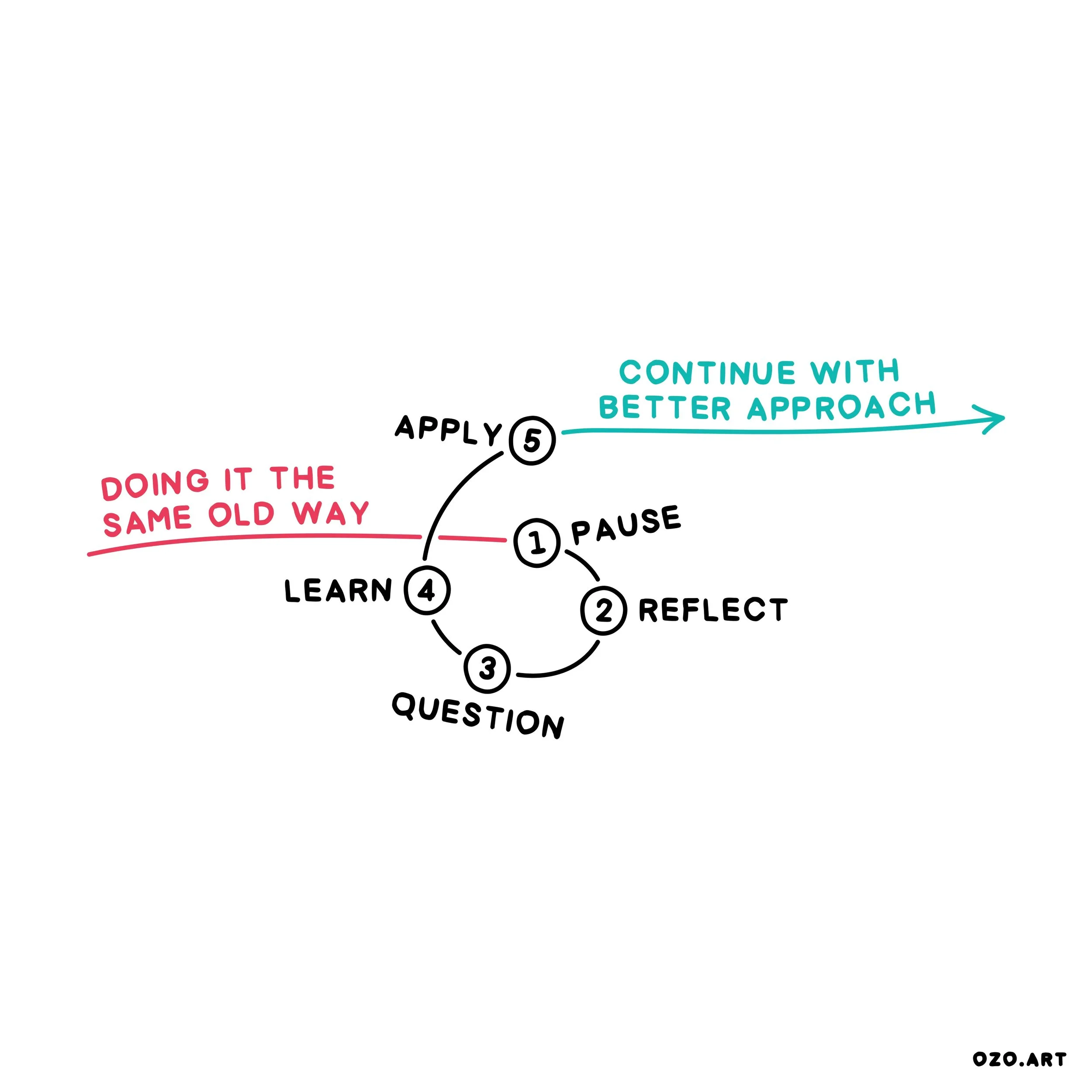
Adopting scientific thinking enhances our ability to navigate uncertainty, make informed decisions, and drive innovation. By applying methodologies like the scientific method, case studies, critical thinking, and collaboration, we can improve how we solve problems and develop strategies in business and everyday life.
Thinking like a scientist empowers us to stay curious, embrace experimentation, and refine our understanding. Whether in leadership, entrepreneurship, or learning, scientific thinking provides a powerful framework for success, helping us make sense of the world and thrive in a rapidly changing environment.
Written by Rebecca Agent with credit to the following AI tools for assistance in producing this content:
Research, writing, reader timing and SEO | ChatGPT
The Deep Dive Podcast Overview | NotebookLM by Google
Text to Speech Audio Summary | Eleven Labs
Editorial assistant | Grammarly (English US)
. . .
REFERENCES
[1]: NASA Space Place, May 2021
[2]: Branches of Science by FUN & LEARNING with TEACHER DANNY ONG, Aug 2022
[3]: Is there a better way? Janis Ozolins, Jan 2025
If this content was helpful to you and your work please comment, share, and like !