
Ambiguity: When No Answer Is Coming

Source: @imkaravisual via Unsplash
Summary || When No Answer Is Coming - What Ambiguity Does to a Room
On the questions that get filed as resistance
Most change work treats uncertainty as a supply problem. People are unsettled because they lack information, so send more of it.
The research points somewhere more useful. The same unclear situation produces completely different behaviour in two people sitting in the same row, and the difference gets made after the information arrives.
This piece covers three lenses on that difference: why people ask, why some of them cannot leave it alone, and what the situation comes to mean for them. Then the distinction that matters most in practice, between the uncertainty your change genuinely carries and the ambiguity your organisation has manufactured around it.
-
noun
the quality of being open to more than one interpretation; a lack of decisiveness or commitment.
“the ambiguity of the announcement left everyone guessing”
9min read
what this looks like
Two people sit through the same announcement. Same slides, same room, same careful words about a new operating model and a design that is still being worked through.
One walks out thinking there is something here worth shaping. The other walks out doing the arithmetic on their mortgage.
Nothing in the information accounts for that gap.
Six weeks on, both are asking questions, and both sets of questions get logged in the same column of the same spreadsheet under the same heading. The heading is wrong for at least one of them.
What is this person actually doing when they ask me again?
Two words get used interchangeably in this territory and they are worth separating. Uncertainty is not knowing what will happen. Ambiguity is not knowing what it means. In organisational change they arrive together, and the second one is usually the one people are actually struggling with.
Three lenses on the same unclear situation
Three bodies of research answer three different questions about that moment. They are not stages in a process. They are three ways of looking at the same room.
Why are they asking?
Charles Berger and Richard Calabrese published uncertainty reduction theory in 1975, after studying strangers in first conversations. When people cannot predict what happens next, they are driven to find out. Prediction is what tells them how to behave.
In a transformation, that drive sounds like a list. What exactly is changing. Why now. What does this mean for my role. Who is making the decisions. What happens after this.
Asking, watching how leaders answer, comparing notes in the kitchen, testing whether the stated reason holds up: all of it is work to make the situation predictable again. Most of it looks, from the front of the room, like someone being difficult.
They are trying to get their feet under them.
Why can’t they leave it alone?
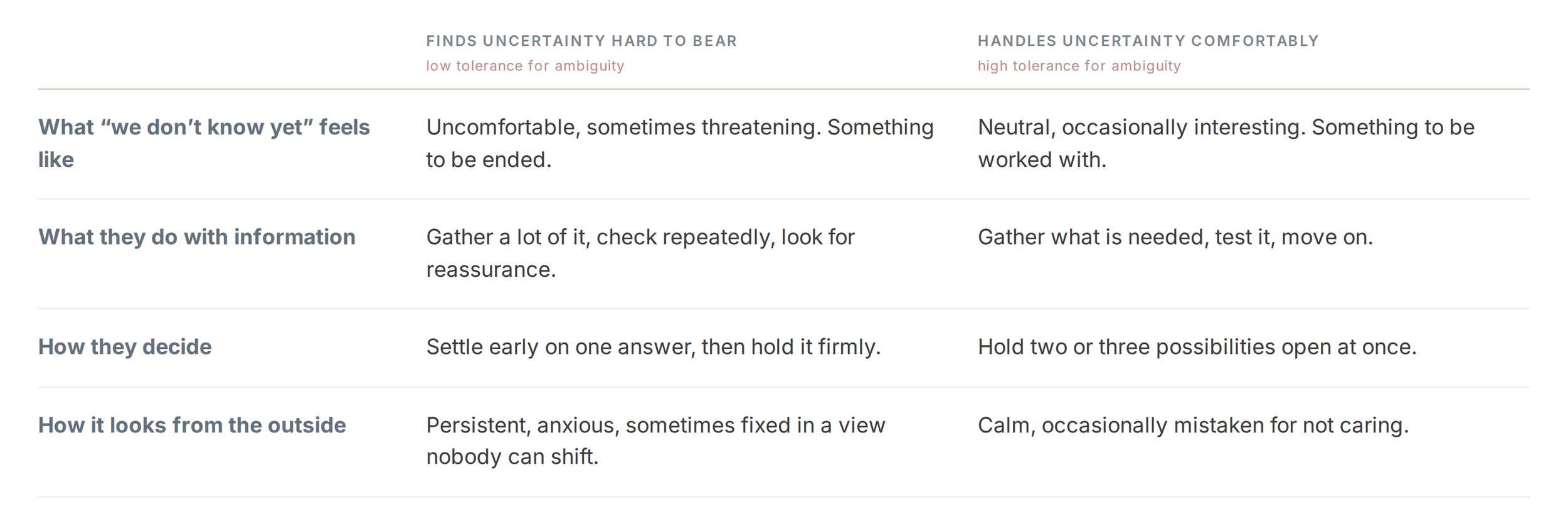
Michel Dugas and colleagues gave this its clearest name through the late 1990s: intolerance of uncertainty. The finding is about the unresolved state itself. For some people, “we don’t know yet” is a neutral fact. For others it lands closer to alarm, and they will work to make it stop.
Arie Kruglanski’s research on the need for closure describes what that work looks like. Seizing, where a person grabs the first available answer because having one beats waiting. Then freezing, where they hold that answer well past the point the evidence supports it.
You have watched this happen. Someone decides in week two what the restructure means, and nothing you say in month five shifts them, because the answer stopped being provisional the moment it arrived.
Two ways of holding an open question
What does it come to mean for them?
Richard Lazarus and Susan Folkman published their model of stress and coping in 1984, and it is the lens that changes what a leader can actually do.
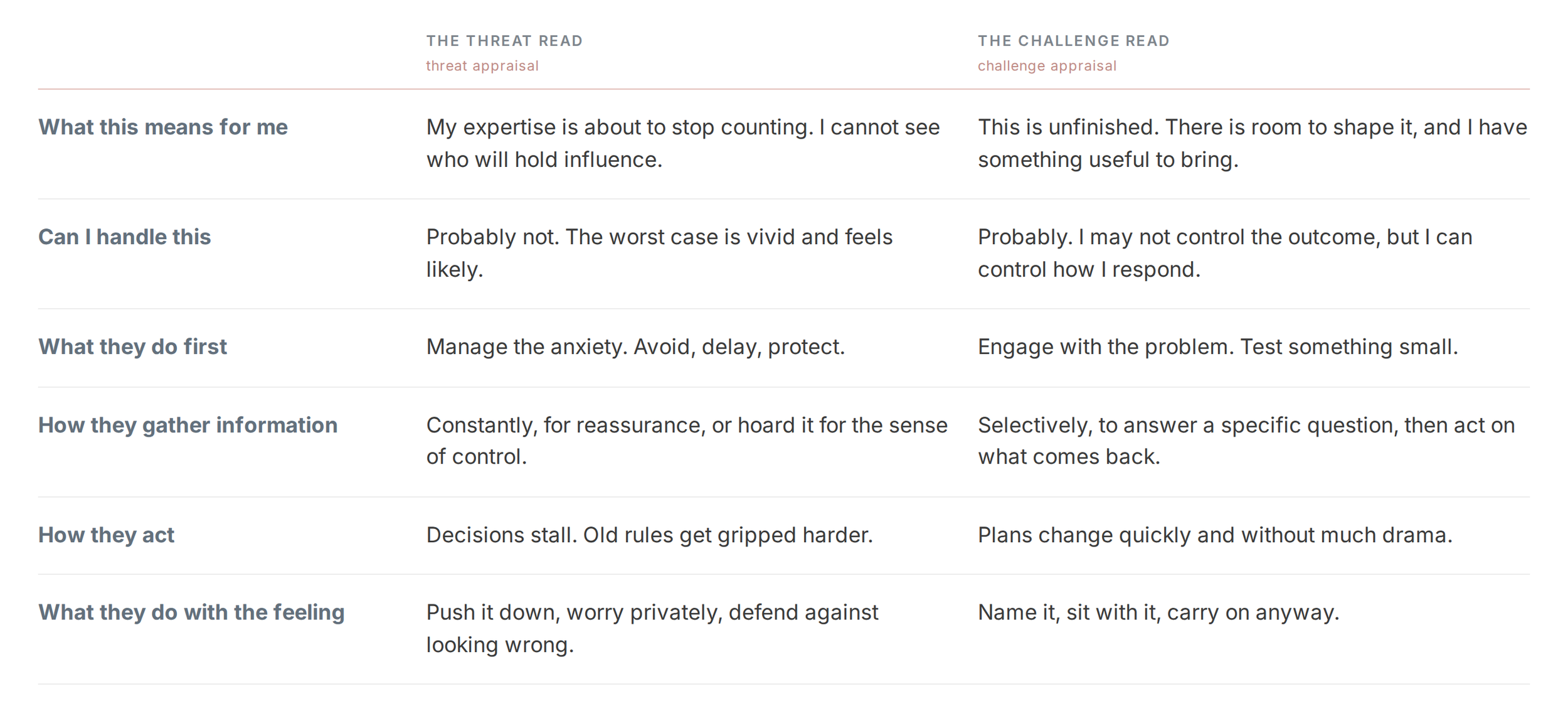
A person sizes up a situation before they respond to it. They ask two questions, usually without noticing, and the answers set everything that follows.
The first is what this means for me. Harm and loss on one side, difficulty I can work with on the other. The second is quieter. Can I handle this. That one turns on whether the person has evidence of their own influence, not on how encouraging you have been.
The two questions, and what each answer turns into
The reading becomes the reality
A read, once taken, has a habit of sealing itself shut. Two ordinary thinking shortcuts do the sealing, and both get stronger the less clear the situation is.
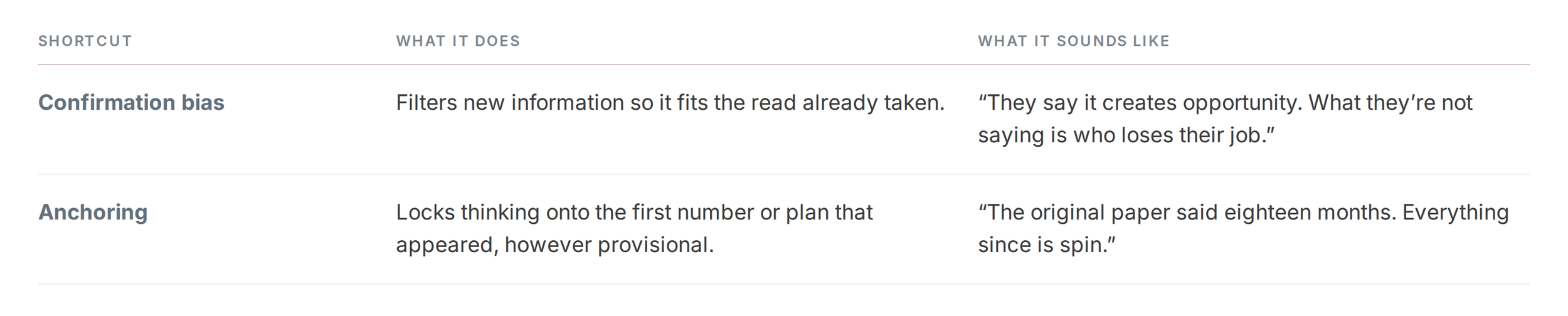
Which is why the third update lands the way it does. The message goes in whole and comes out as further evidence for the view already in place.
Look at the conditions before you look at the person
There is a trap in the personality research, and it is worth naming before someone uses it to sort their team into piles.
Walter Mischel’s work showed that stable traits express themselves differently depending on the situation. The trait sets a baseline. The conditions decide how loudly it plays. Someone who normally handles ambiguity well will still go rigid in a culture that punishes visible mistakes, and someone who finds it hard can function well inside a sequence that makes the unknowns legible.
So the person in the fourth row is not simply built for this or not built for it. They are responding to conditions you designed.
Take two transformations with identical strategic intent and roughly identical real-world uncertainty.
In the first, the case for change is clear, leaders say out loud what is genuinely unknown, people understand how decisions will get made, there are real openings to shape the design, and progress is visible on a schedule.
In the second, the rationale shifts depending on who is speaking, leaders imply a confidence that does not exist, decisions appear arbitrary, information arrives in fragments through three channels at different times, and nobody can influence anything that matters.
The uncertainty on paper is the same in both. The uncertainty people live inside is a different order of thing.
The uncertainty you have to live with, and the ambiguity you created
This is the distinction I would take into any programme.
Necessary uncertainty is the future not being known yet. The operating model is genuinely still being designed. The roles are genuinely not final. The technology decision is genuinely unmade, and the leaders are genuinely learning as they go. There is nothing to send, because nothing exists to send.
Manufactured ambiguity is everything else. A decision nobody has made. A sequence nobody has published. A decision rule nobody has written down. Three channels releasing different versions in the same week.
And one more, which is the leader’s own contribution. Overconfidence sits mostly at the top of organisations, because certainty reads as competence in a steering committee. Saying “we’re very clear on where this lands” when you are not manufactures ambiguity twice over: once now, and again in six months when people work out that your reassurance was not load-bearing.
Organisations create the first kind of uncertainty through what they change. They create far more of the second kind through the conditions they build around the change, and that portion is a choice. Somebody designed it. It can be designed differently.
Which moves the question a change leader should be asking. The familiar version is how do we get people comfortable with uncertainty, and it has the wrong subject in the sentence. The better version has three parts.
What uncertainty is built into this change and cannot be removed. What ambiguity are we manufacturing on top of it. And what conditions help people take a challenge read on what is left.
The work is creating conditions in which people can move while certainty is unavailable.
Do that sorting and the three things hiding under one heading come apart.
Three different things, all filed as resistance
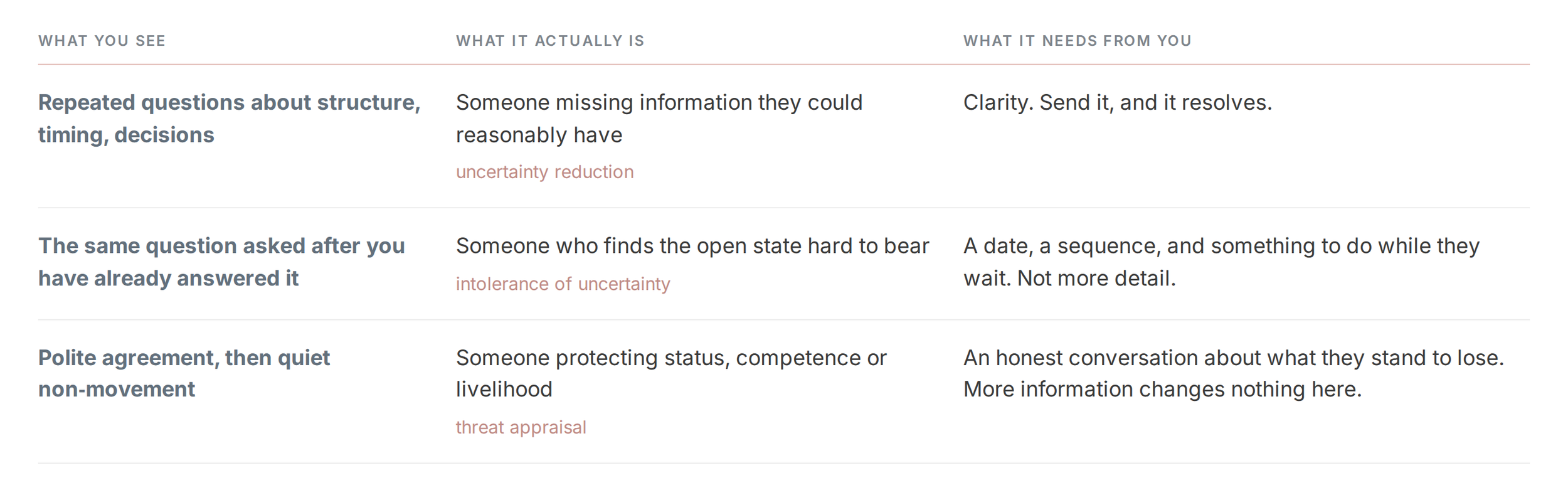
From the outside these look identical. Someone keeps asking about the future structure. The response each one needs has almost nothing in common with the other two, and a communications plan is aimed only at the first.
When the destination keeps moving
AI adoption is where this gets sharpest, because the uncertainty sits on a longer horizon than any programme plan.
A restructure resolves. Twelve months on, people know where they sit. AI-driven change offers no such landing. The honest answer to “what will my job look like in three years” is that nobody in the organisation knows, including the person answering.
Most of the change toolkit assumes you will eventually be able to tell people. The tools assume a destination.
What changes in the work
Four things move once you separate necessary uncertainty from manufactured ambiguity.
Split the fog into two columns. Sort every unknown in your change into what cannot be resolved yet, and what is unresolved because of a decision, a sequence or an admission nobody has made. The second column is your backlog. It is usually longer than anyone expects, and it is entirely within your control.
Put dates on the unknowns. An open question with a date attached behaves completely differently from one floating free. “Role design lands in March” gives people something to hold that is not an answer. It turns an indefinite wait into a defined one, and people can do a defined wait.
Publish the decision rules, not the decisions. People can wait for an outcome. What corrodes is not knowing how the outcome will be reached. Who decides, what evidence counts, what would change the answer. Decision rules can be shared long before decisions are made, and they cost nothing to release.
Give influence that is real. The second question, can I handle this, is answered by evidence of your own influence. People can tell consultation theatre from the real thing within about one meeting. Hand over something genuinely undecided, small if necessary, and let the outcome visibly follow from what they said. One real decision does more than six months of engagement activity.
Three questions to take into the work you are already doing.
Who has asked you the same thing three times, and what would actually settle it for them? If the answer is information, send it. If the answer is a decision you have not made, your problem is a decision.
Which of your open questions have no date attached? Attach one this week, even if it is only a date for the next date.
Where are you speaking with more confidence than the evidence supports? Every one of those is a credibility cost, payable at the moment you most need to be believed.
Closing reflections
Ambiguity produces a question. The person answers it with everything they have: their history with uncertainty, their sense of whether they can handle what is coming, their read on whether this place has ever rewarded anyone for waiting patiently.
I have come to think “I don’t know yet” is one of the more trustworthy sentences available to a leader, on the condition that it never travels alone. Here is what is decided. Here is what is genuinely open. Here is when you will hear more. Here is the part you get to shape.
Said on its own, it sounds like drift. Said with those four things attached, it is the most stable thing in the room.
What I notice in change work that holds is rarely a better communications plan. It is a leader who has worked out which uncertainty they are obliged to sit in, and which they have been careless enough to create.
A room can tolerate a great deal of not knowing. What it cannot tolerate is not knowing how it will find out.
Most of the fog in a change programme was never weather. It was manufactured on site.
The question worth sitting with: how much of what your people cannot see is genuinely unresolved, and how much of it is simply undisclosed?
. . .
Researched and written by Rebecca Agent, with credit to AI tools for assistance in producing this content:
Editorial and grammar writing assistant | Grammarly (English US)
Research, writing, reader timing and SEO | ChatGPT, and Claude
The Deep Dive Podcast Overview | NotebookLM by Google
Topic research to link peer-reviewed research papers | Storm Genini Stanford; Google Gemini, Perplexity
Key Thinkers
Amos Tversky & Daniel Kahneman, Judgment under Uncertainty: Heuristics and Biases, Science (1974)
Arie Kruglanski & Donna Webster, Motivated Closing of the Mind: “Seizing” and “Freezing”, Psychological Review (1996)
Charles Berger & Richard Calabrese, Some Explorations in Initial Interaction and Beyond, Human Communication Research (1975)
Michel Dugas, Mark Freeston & Robert Ladouceur, Intolerance of Uncertainty and Problem Orientation in Worry, Cognitive Therapy and Research (1997)
Richard Lazarus & Susan Folkman, Stress, Appraisal, and Coping, Springer (1984)
Walter Mischel & Yuichi Shoda, A Cognitive-Affective System Theory of Personality, Psychological Review (1995)
Related pieces
If this content was helpful to you and your work please comment, share, and like !