
Move the Room: A Working Guide to Building a Talk That Lands

Source: @hulkiokantabak via Unsplash
Summary || Move the Room: A Working Guide to Building a Talk That Lands
The structure, moves, and craft behind a talk that moves the room, in a form you can come back to.
Most talks inform. A few move the room. What separates them sits underneath the delivery, in the architecture: a shape built backwards from one change you want in the people in front of you. This piece looks at what actually moves a room, why it matters now, why the good structures work, how you build one, and the part that stays yours no matter how much of the drafting you hand to a machine.
This is a reference for the work of building a talk or a presentation: what to decide first, which structures to reach for, and the smaller craft that makes a single point land. Use it while you're planning, and come back to it when a draft is clear but flat, or when you're stuck on shape.
-
verb
to prompt someone to action; to stir feeling; to change position.
“A talk succeeds only if it moves the room.”
noun
a deliberate device used to land a point.
“The pause is the most under-used move there is.”
9min read
What is this
There's a moment, maybe ninety seconds in, when you know whether a room is with you or just being polite.
The air changes. People stop reaching for their phones. The small shuffling settles. You've earned the next twenty minutes, or you'll spend them talking to the tops of heads.
Every talk that moves a room is built backwards from one shift. One change you want in the people listening: what they now see, feel, or are willing to do that they didn't when they walked in. Name that shift first, and the structure has something to serve. Skip it, and you get a tidy talk that informs and moves no one.
Underneath the shift, the same engine runs in every talk that lands: tension, movement, resolution. You give people a reason to keep listening. You take them somewhere. You give them somewhere to land. Almost every structure worth knowing is a way of turning that engine.
Why this matters now
For most of the history of business, building a good talk was the hard part. Structuring the argument, drafting it clearly, making the deck: that took skill and time, and being good at it set you apart.
That part just got cheap. A model will hand you a clean structure, a full draft, and a tidy deck in minutes, at a standard that clears the old bar. So the value moves to the one stretch that can't be automated: standing in front of people and shifting them.
The skill gets scarcer this way, and the stakes on each moment get higher. Fewer set-piece talks, more riding on each one: the board update, the all-hands, the keynote. Those are where the human premium shows, and where a room is won or lost.
There's a second reason it matters, closer to leadership. A talk that moves a room is influence at scale. It shifts many people at once, which one-to-one work can't. For anyone whose job is tilting from doing the work to leading through others, that makes it one of the most powerful hours you have.
How to move the room
Start with the shift
Before any structure, answer two questions.
The occasion. Who is in the room, why are they there, and what is the setting asking of you?
The outcome. What is the one shift you want? The single change in the people listening: what they see, feel, or are willing to do afterwards that they didn't when they walked in.
Name the shift first. Everything below, structure, moves, humour, exists to serve it. A talk with no named shift informs and moves no one.
The kind of shift. Most shifts are one of four. Knowing which one you're after changes how you build.
Believe. Change what they hold to be true. A reframe, or an understanding they didn't have before.
Feel. Change the emotional register. Urgency, confidence, hope, or useful discomfort.
Decide. Move them to a choice or a commitment. A yes.
Do. Move them to a concrete next action.
Most business talks aim at believe, at transferring understanding, when the moment called for decide or do. Feel is the lever people skip, though it's often what makes the other two land. Name the real shift, and you stop informing a room that needed moving.
The aim. The shift is what changes in them. The aim is what you do to cause it. Four aims move a room. Informing on its own is the default that doesn't, which is why it isn't on this list.
Insight. Change how they see. A reframe that reorganises what they already knew.
Inspiration. Move them to feel, and to want the change.
Persuasion. Win a decision or a yes.
Align. Bring a mixed room to a shared frame and a shared direction.
The aim picks the loadout. It points to the structure, the openings, and the moves that fit. The Aim column in the table below maps structure to aim, so you can start from either end.
1. Structure: the spine
The spine is the shape of the whole talk. Pick the one that carries your shift, then draft into it.
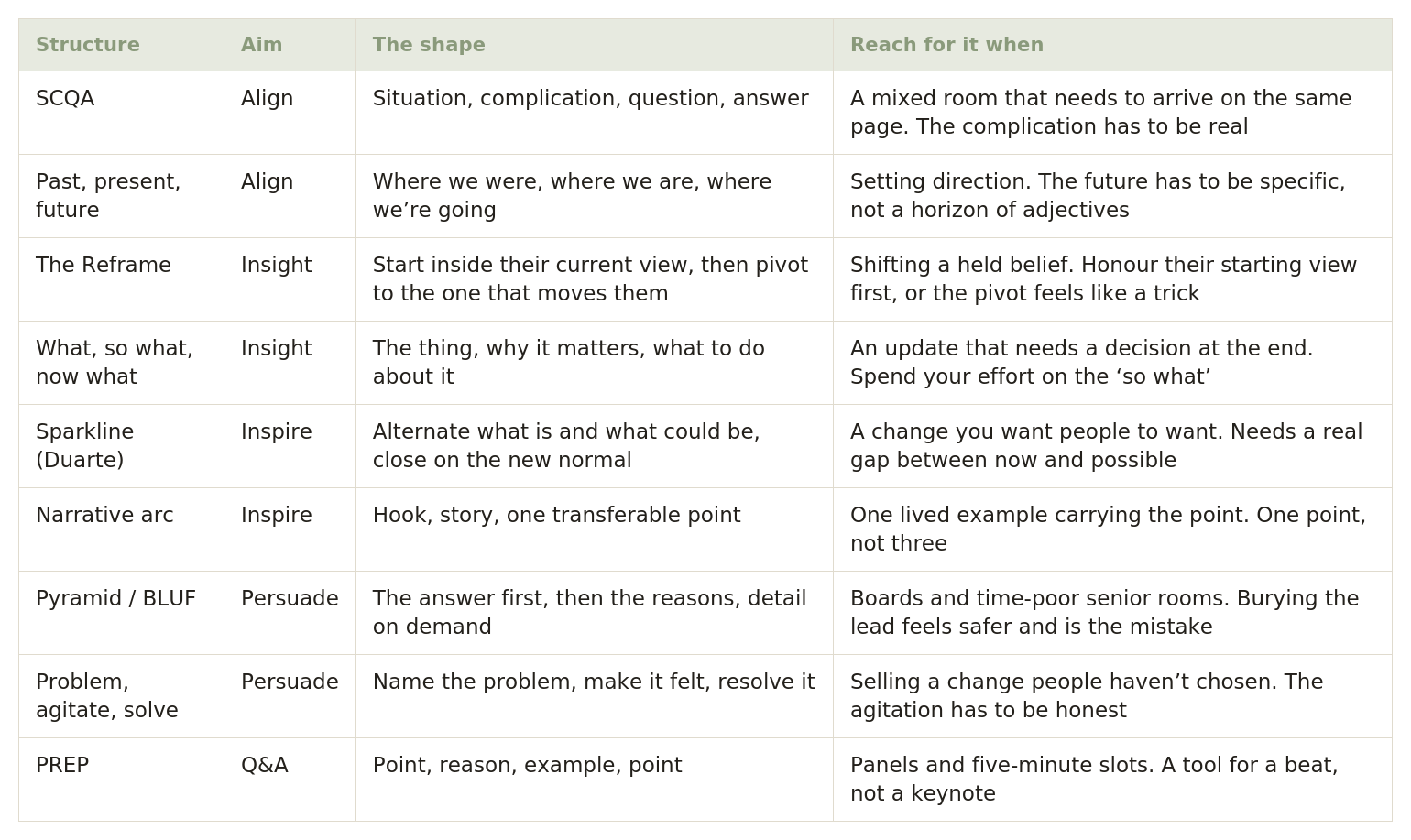
You won't need all of them. Match the aim to the spine, draft into it, then get out of its way. Reaching for a familiar shape out of habit is how a talk sags. The tool's full library holds more of these; this is the working set.
2. The moves: making a single point land
Structure carries the whole talk. Moves carry the sentence. Use them on purpose, and sparingly.
Tricolon. Three beats, the weight on the third. Often paired with a topper.
The concrete specific. The number, the name, the object. The difference between heard and believed.
One clean analogy. A single bridge to something familiar. One, not a parade of them.
The pause. Silence after the load-bearing line. The most under-used move there is.
The turn. But, until, then. The hinge most good talks pivot on.
Naming the tension. Say the thing the room is feeling and not saying. Instant credibility.
The implication beat. Claim, evidence, so what. Make the proof answer 'what does this mean for us', not only 'is it true'. Boards move on the consequence, not the fact.
3. Humour: a buildable mechanism
Humour is a release valve, not a performance. It arrives when the load lifts, lands in a clause, and is never for the speaker. The dependable devices:
Rule of three with a topper. Two straight beats, then the third breaks the pattern.
Callback. Return to an earlier line at a new angle. It rewards the people who were listening.
Misdirection. Set an expectation, subvert it on the last word.
Light self-deprecation. Aimed at your role or your certainty, never at your credibility.
Observational truth. Say the thing the room half-knows and hasn't voiced. The laugh is recognition.
The specific. The precise detail is funnier than the general one. Always.
Read the setting from the brief. Grief, high-stakes decisions and hostile rooms want none. If a line is for you and not for them, cut it.
And the rest: openings, joins, closings
Openings. Choose one deliberately: a sharp question, a startling specific, a short scene, a bold claim, or a striking image. One worth naming on its own is the confession, where you go first and earn the trust to ask the room to. “I've spent 27 years on the ground floor; the balcony still gives me vertigo.” Keep it past-tense and genuinely earned, and match it to the setting: strong in a keynote, riskier in a board room.
Transitions and signposting. Name where you are, bridge between points, and drop the occasional short internal summary. Weak joins, more than weak points, are what make a talk feel rough. Signpost the turns.
Closings. Land it, don't trail off. Call back to your opening, project a specific new normal, end on one resonant line, or leave a provocation that follows them out of the room. Never close on a limp summary.
Handling a sceptical room
For senior rooms that arrive doubtful, this is often the real work. A few moves earn the right to be heard.
Name it first. Say their objection before they do. It disarms.
Steelman, then turn. Give their view its strongest form, then move. They follow you further once they've been heard.
Concede the small, hold the large. Yield what is genuinely true, keep the core.
Surface the risk they carry. Name the cost of doing nothing, not just the upside of your ask. A decision room feels the loss more than the gain, so make the downside of standing still visible before you ask them to move.
Why these work
The craft above is evidence-backed, though the field is full of folklore too. In brief:
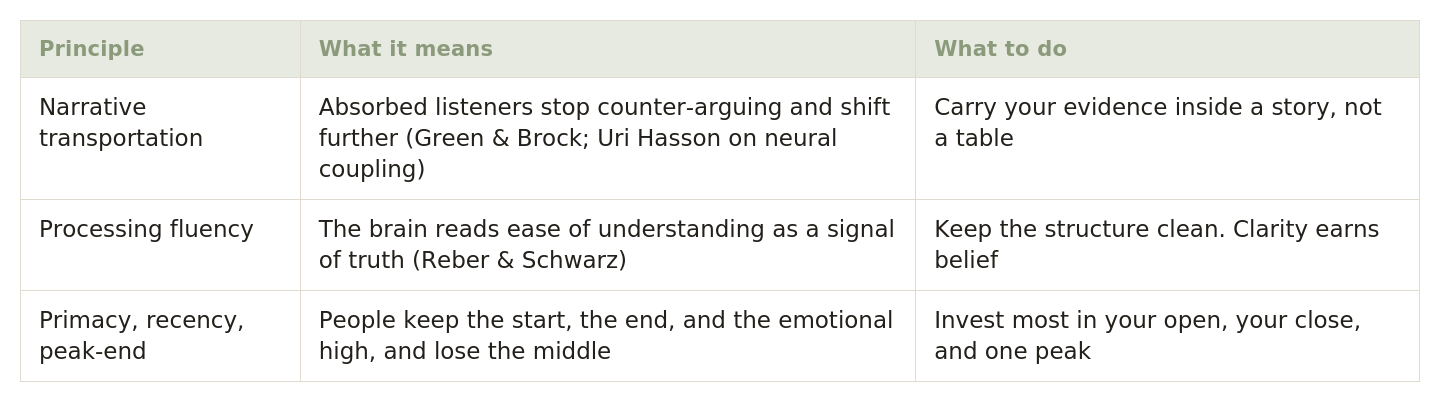
And know the folklore, so you don't lean on it:
The 7/38/55 rule (words, tone, body language) is a misreading of Mehrabian's single-word studies. It never described a talk.
Power posing, the two-minute superhero stance, didn't survive replication.
Matching your delivery to someone's “learning style” has almost no evidence under it.
Telling the sturdy research from the confident myth is part of the craft.
Putting it together
The workflow is four steps: brief, spine, draft, room.
Brief. Occasion, audience, and the one shift.
Spine. Choose the structure that carries the shift.
Draft. Scaffold it: opening, sections, moves, humour, close.
Room. Rehearse aloud. Pace, filler, presence.
The first three steps are buildable, and a tool can do them well: hand it the occasion and the shift, and it can return a spine, draft into it, pull the right moves, and flag a weak open or a buried point. The mechanical layer automates cleanly.
The fourth step stays human. Speech-coaching tools cut anxiety and catch your filler words and pace with real accuracy, but they can't read the room: the humour that lands or dies, the subtext, the moment a story takes hold. The drills sharpen the delivery. Presence comes from reading the room live and adjusting.
Length changes the loadout. The shift stays at one, whatever the running time.
Five minutes. One shift, one structure (PREP or Pyramid), one device, no subplots.
Twenty minutes. One shift, one structure, three sections, two or three devices, one story.
Forty-five and up. One shift still, now with room for a subplot, a callback arc, more story, and real pauses.
More time is not more points. It is more room to let one point land.
The one test
Before you build anything, and again before you finish, answer the question the whole thing hangs on. What is the one shift you want in the room, and does every choice, structure, moves, humour, opening, close, serve it?
If a section doesn't serve the shift, cut it. That is the whole method.
Did it land? Afterwards, the principle is still checkable, and the test changes with the aim.
Insight. Can they name the thing they couldn't see before?
Inspiration. Did the energy in the room lift, and did someone move to act?
Persuasion. Did they decide, or move visibly toward the yes?
Align. Could two people in the room now say the same thing back?
Closing reflection
The architecture gets you a talk people can follow: the spine, the moves, the clean joins, the shape that serves the shift. All of it is buildable, and more of it is automatable than most of us realised a year ago.
What moves a room is the part that stays with you. Sensing the shift at ninety seconds. Feeling the energy tip. Adjusting live, in a way no spine can script.
Build the tool for the spine. The room stays yours.
Researched and written by Rebecca Agent, with credit to AI tools for assistance in producing this content:
Editorial and grammar writing assistant | Grammarly (English US)
Research, writing, reader timing and SEO | ChatGPT, and Claude
The Deep Dive Podcast Overview | NotebookLM by Google
Topic research to link peer-reviewed research papers | Storm Genini Stanford; Google Gemini, Perplexity
. . .
Key thinkers
Melanie Green & Timothy Brock, Narrative Transportation (2000)
Uri Hasson, Brain to Brain Coupling in Narrative (2012)
Rolf Reber & Norbert Schwarz, Processing Fluency (2004)
Nancy Duarte, Resonate - the Sparkline (2010)
Barbara Minto, The Pyramid Principle, source of SCQA (1987)
Alan Monroe, Monroe's Principles of Speech - the Motivated Sequence (1935)
Voices in the field worth following: Vinh Giang on delivery and presence, Matt Abrahams on impromptu speaking and Q&A.
. . .
See related pieces (on the blog) :
How to Tell Stories That Stick — the deeper dive on narrative and neural coupling, the mechanism this piece only touches.
Craftsmanship in Modern Work — care, judgement, standards, and the part of the work a tool can't do.
Change in the Face of AI — the wider version of the why-now: where the human premium moves as AI does the drafting.
Orchestration: The Craft of Creating Conditions — doing the work versus leading through others, the influence-at-scale thread.
If this content was helpful to you and your work please comment, share, and like !